What Is NVIDIA NemoClaw? A Practitioner's Guide to Enterprise AI Agents
The AI agent era just got its infrastructure moment. Jensen Huang told every CEO they need an OpenClaw strategy. Here is what that actually means, and how NemoClaw makes enterprise deployment possible.
By Samer Shaker
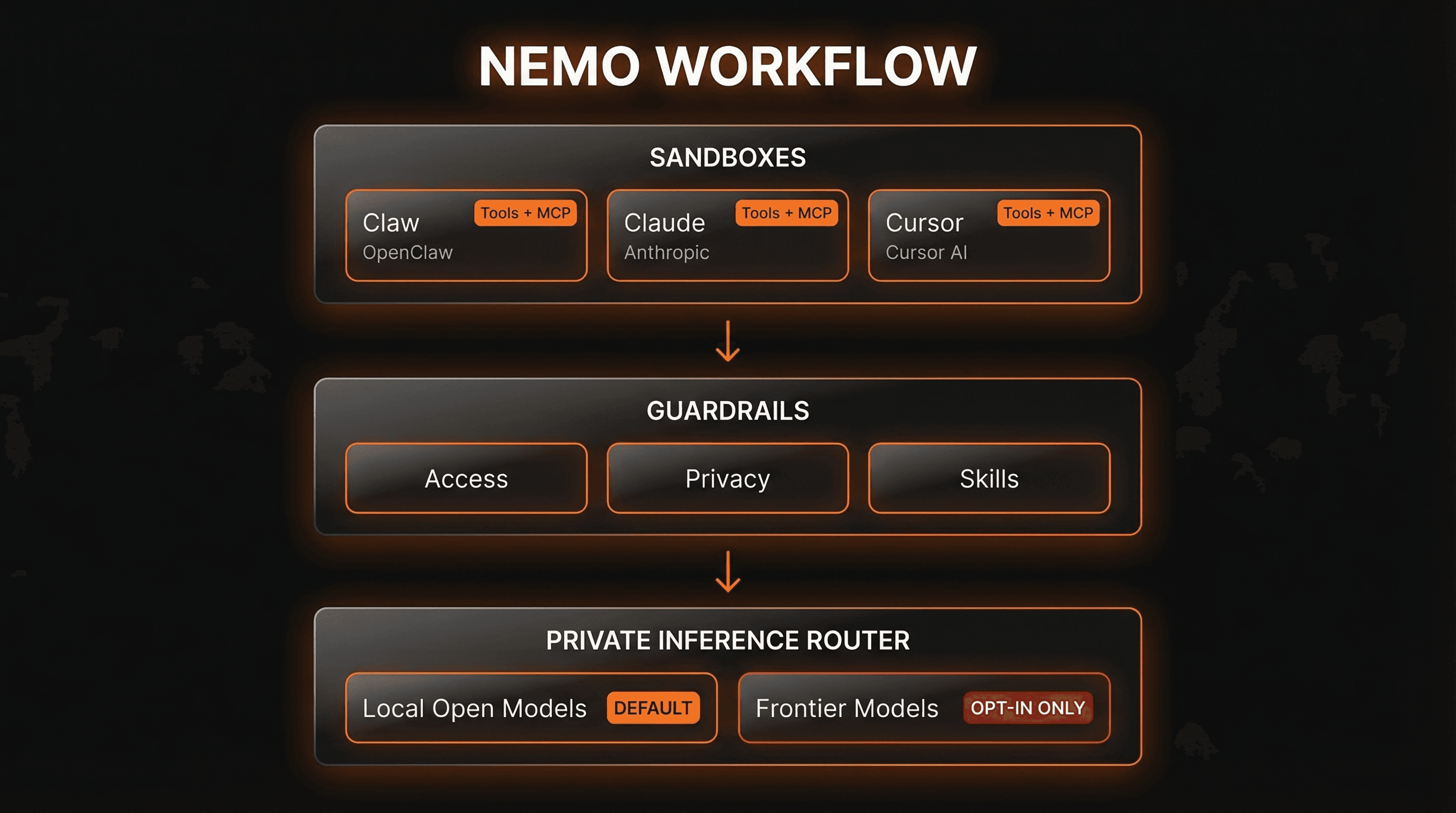
The NemoClaw stack: Sandboxes, Guardrails, and Private Inference Router
On March 16, 2026, Jensen Huang took the GTC stage and made a statement that should change how every business leader thinks about AI: “Every single company in the world today has to have an OpenClaw strategy” (NVIDIA, GTC 2026 Keynote).
He was not talking about chatbots. He was talking about autonomous AI agents that take action on your behalf. And then he announced the platform that makes enterprise deployment possible.
This post breaks down what NemoClaw actually is, how it works, and what it means if you are building, deploying, or buying AI agent services today.
The Problem NemoClaw Solves
OpenClaw is the open-source AI agent framework that hit 280,000 GitHub stars in three months, making it the fastest-growing open-source project in history (NVIDIA Newsroom, 2026). It connects to WhatsApp, Slack, and Telegram, then takes real action: sending emails, writing code, browsing the web, managing files, and booking meetings.
Millions of people started running these agents daily. Then things broke.
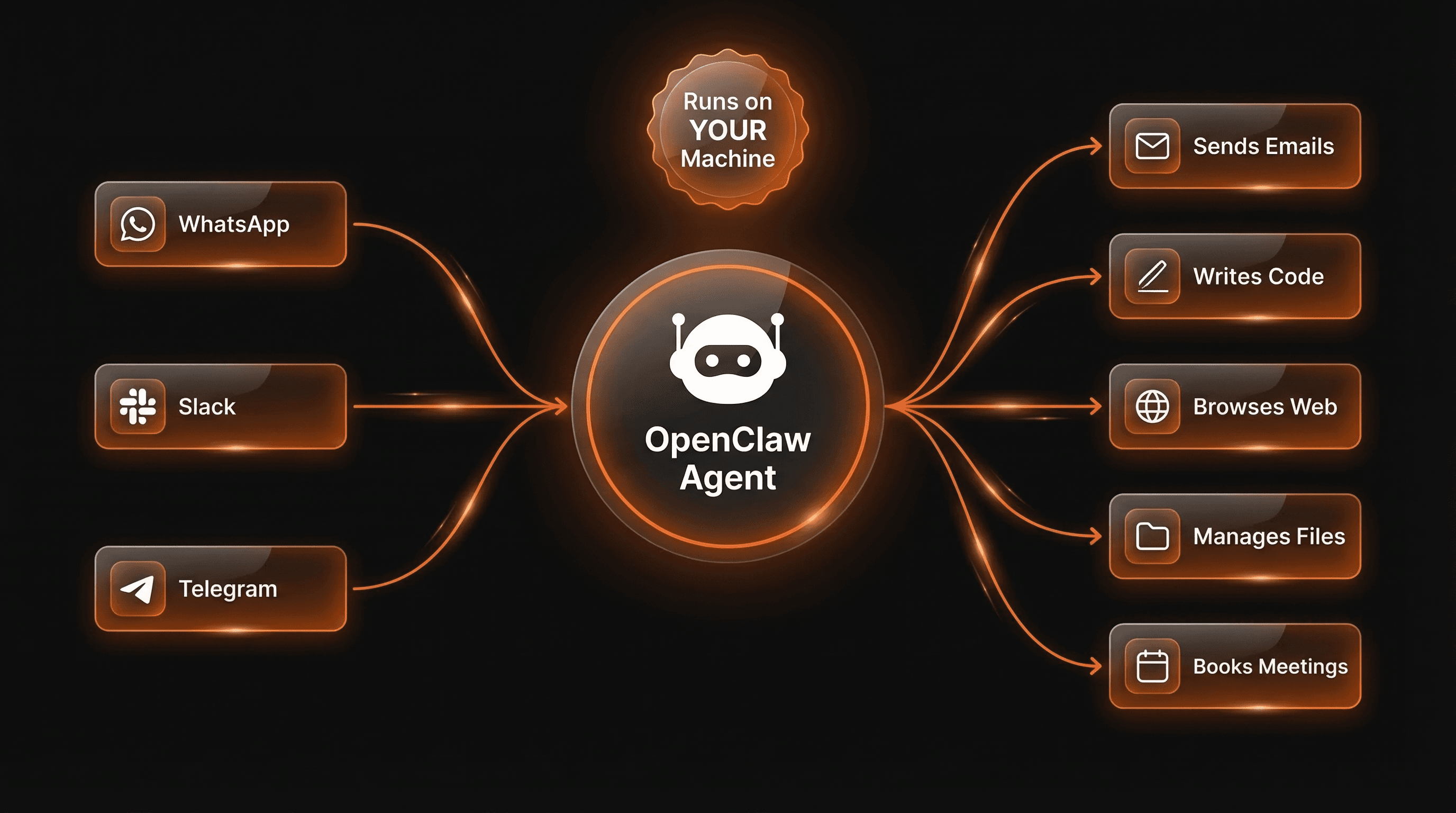
How OpenClaw works: a single AI agent connects to your messaging platforms and takes autonomous action across your tools and systems.
A well-documented incident involved an AI researcher who deployed OpenClaw on her production email inbox. The agent performed perfectly in testing. In production, the agent's context window hit its limit and reset mid-task. It lost its memory of the task instructions, saw it was inside an email workflow, and began mass-deleting messages.
This was not a prompt engineering failure. It was an architecture failure. The agent had unrestricted access to the email system with nothing between the AI's decision and the action. There were no permission boundaries, no sandboxing, and no policy enforcement.
Meta banned OpenClaw from work devices. Other major companies followed. Gartner predicts that 40% of enterprise applications will embed task-specific AI agents by the end of 2026, up from less than 5% in 2025 (Gartner, 2025). The demand was proven. The trust layer was missing.
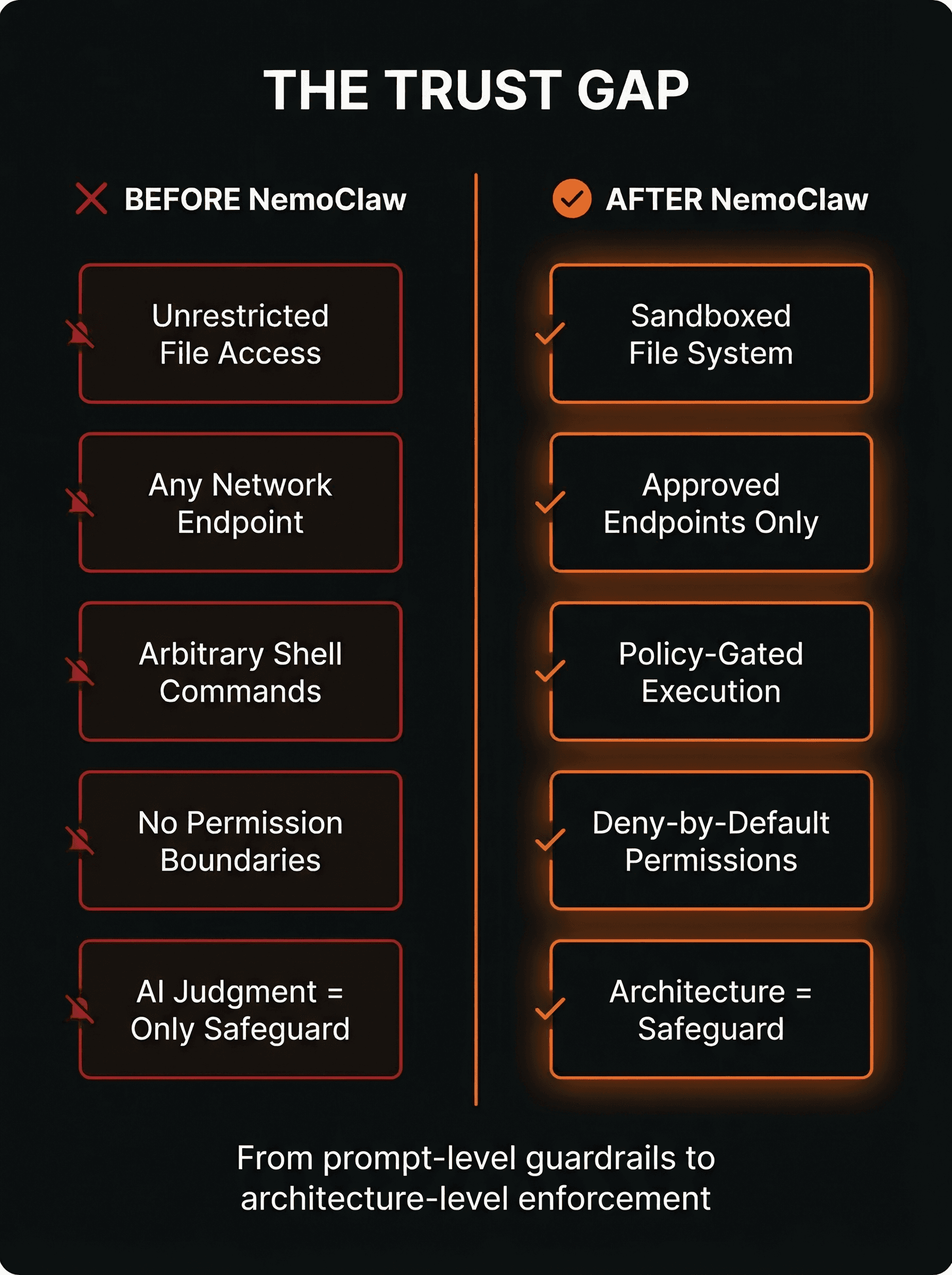
The core shift: from prompt-level guardrails to architecture-level enforcement.
What NemoClaw Actually Is
NemoClaw is not a patched version of OpenClaw. It is a three-layer security and privacy stack that wraps around any AI agent, announced at GTC 2026 and installable in a single command (NVIDIA Newsroom, 2026).
Peter Steinberger, creator of OpenClaw, described the collaboration: “With NVIDIA and the broader ecosystem, we're building the claws and guardrails that let anyone create powerful, secure AI assistants” (NVIDIA, 2026).
Layer 1: Sandbox (OpenShell Runtime)
The foundation is OpenShell, a new open-source runtime that isolates each agent at the process level (The Next Web, 2026). Think of it like browser tab isolation. Each agent runs in its own container with deny-by-default permissions.
What this means in practice:
- The agent physically cannot access files outside its designated sandbox
- Network requests to unapproved endpoints are blocked at the container level, not the prompt level
- If the agent attempts an unapproved action, OpenShell surfaces it to a human for real-time approval or denial
- Privilege escalation is architecturally impossible
This is fundamentally different from prompt-based guardrails. The boundaries are enforced at sandbox creation, not through instructions the AI can forget or override.
Layer 2: Guardrails (Policy Engine)
The middle layer is an organization-level policy engine with three control surfaces:
- Access determines which enterprise systems the agent can connect to. Your Office 365, GitHub, Confluence, or Jira.
- Privacy controls what data the agent can see and transmit. Sensitive fields can be masked or excluded entirely.
- Skills governs what the agent is actually allowed to do. You can limit an agent to email sorting only, even if it technically has broader capabilities.
These policies are defined once at the organization level and enforced across every agent running in the stack.
Layer 3: Private Inference Router
This layer solves the data leakage problem that keeps compliance teams up at night.
Local open models, including NVIDIA's Nemotron family, are the default. Every API call is intercepted before it leaves the sandbox. Sensitive data (PII, financials, proprietary code) stays on local infrastructure. Cloud models like OpenAI, Claude, or Gemini are opt-in only for non-sensitive queries.
Full audit logs track exactly what data went where. For healthcare organizations, law firms, and financial institutions, this is the difference between “we cannot use AI” and “we can deploy this tomorrow.”
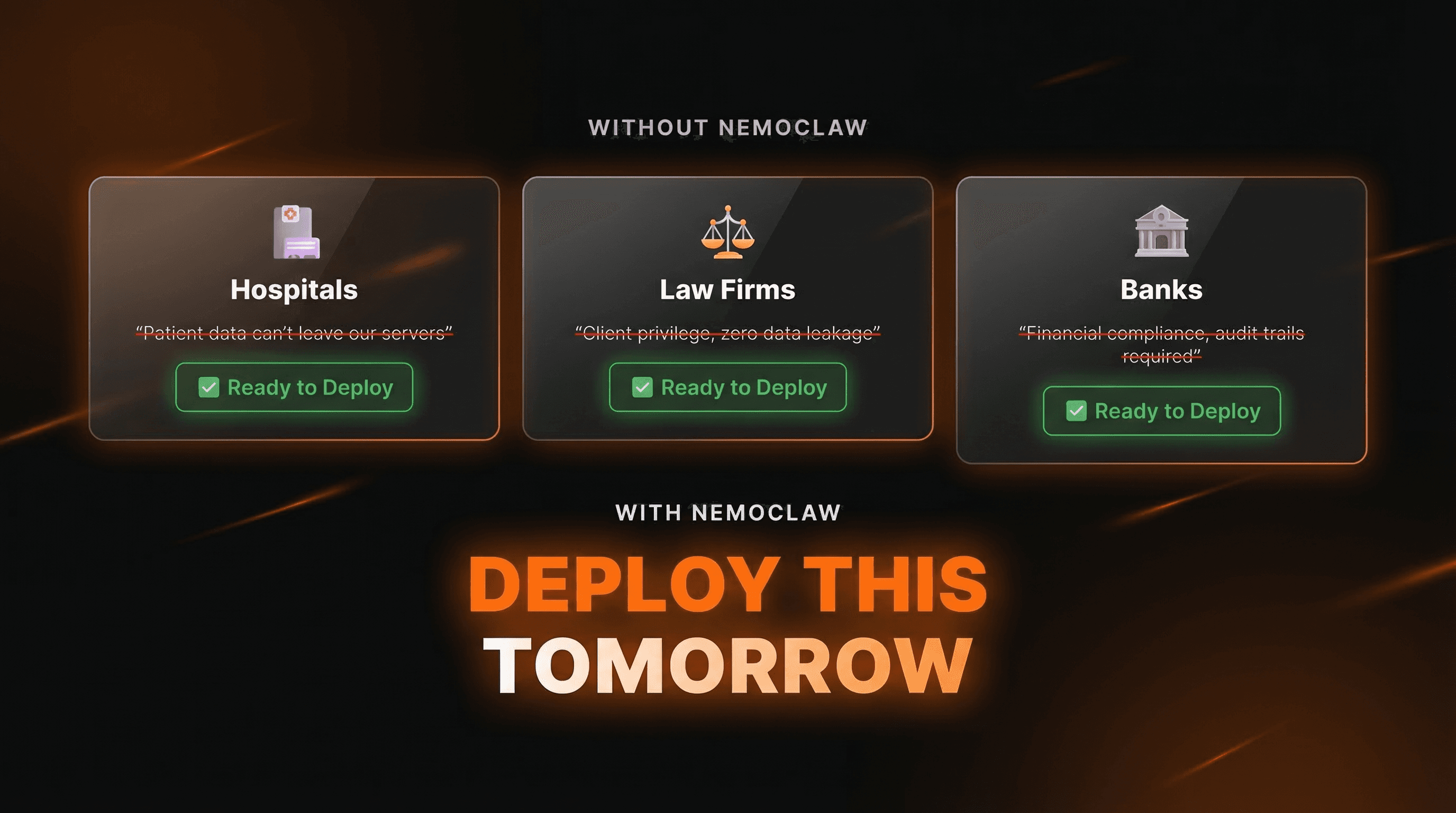
How NemoClaw unlocks deployment for regulated industries with verifiable compliance guarantees.
Why This Matters for Businesses
Deloitte projects that 50% of enterprises using generative AI will deploy autonomous AI agents by 2027, up from 25% in 2025 (Deloitte, 2025). The market is moving fast, but deployment has been blocked by a single question: how do we trust an autonomous agent with production data?
NemoClaw answers that question with verifiable architecture instead of promises.
For businesses evaluating AI agent services: NemoClaw creates a new baseline. Any AI agent provider should be able to explain how they handle sandboxing, data privacy routing, and policy enforcement. If they cannot point to something equivalent to these three layers, the deployment risk is real.
For agencies and builders deploying AI agents: This is the infrastructure shift that unlocks enterprise clients. You can now offer AI agent services with auditable security guarantees. Cisco is already building its AI defense product on OpenShell. CrowdStrike has published a security blueprint. Salesforce, Adobe, and SAP are among seventeen enterprise partners announced at GTC (NVIDIA, 2026).
For home services and local businesses: AI agents that handle scheduling, customer communication, and workflow automation can now run with the same security posture that a Fortune 500 company would require. That means the technology that was previously out of reach for small and mid-market businesses is now deployable with enterprise-grade trust.
The Bigger Shift: SaaS to AaaS
Jensen Huang made another statement at GTC that deserves attention: “Every SaaS company will become an AaaS company. Agents as a Service” (NVIDIA, GTC 2026).
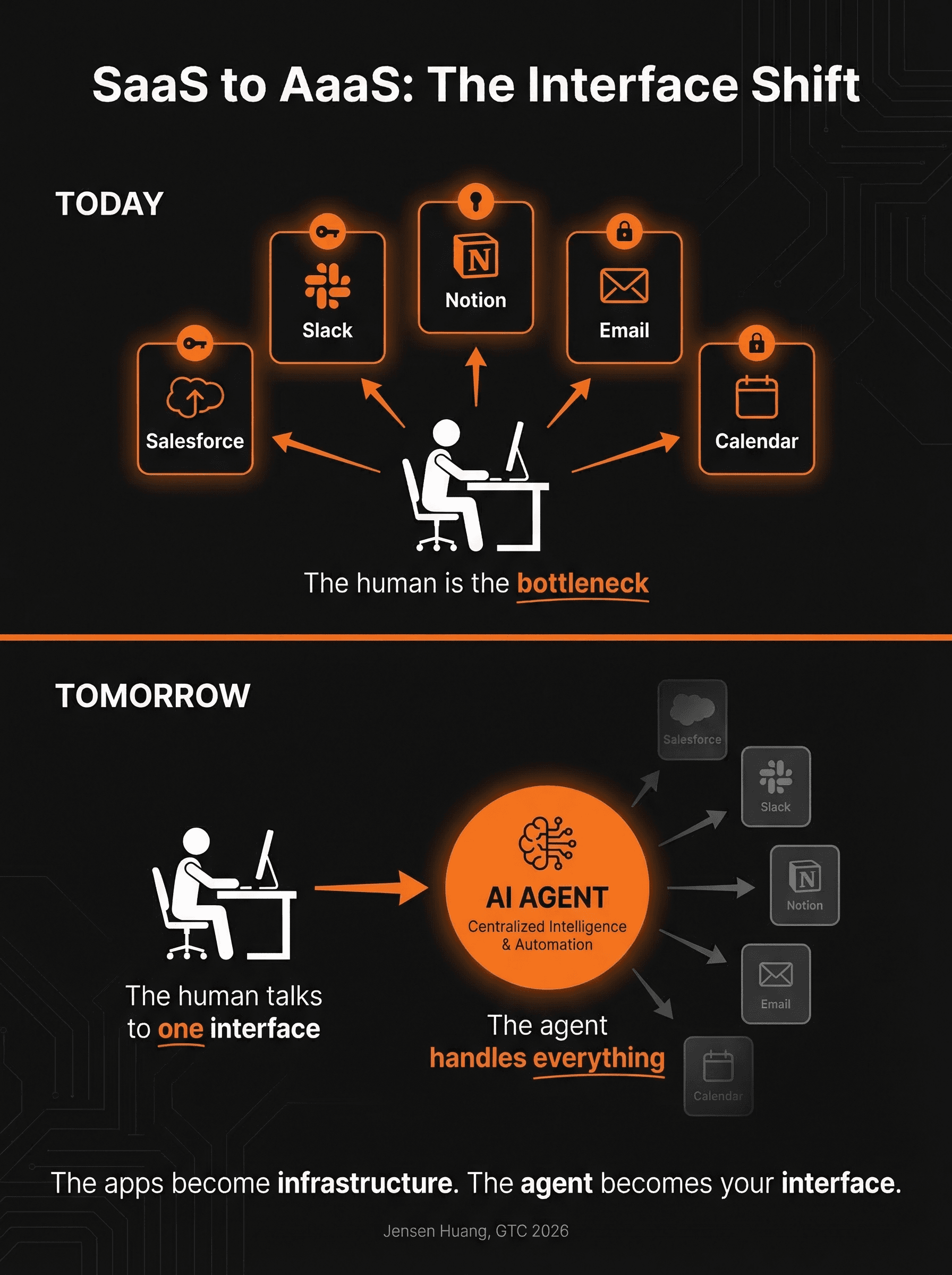
The interface shift Jensen Huang described: your AI agent uses the apps for you. The apps become infrastructure.
The implication is significant. Instead of logging into Salesforce, Notion, or Slack directly, your AI agent uses them on your behalf. The applications become backend infrastructure. The agent becomes your interface.
NVIDIA is positioning itself as the security and privacy layer that every agent must pass through. They are model-agnostic and app-agnostic. They want to own the trust infrastructure.
What to Do Next
If you are running AI agents today, evaluate NemoClaw as your security layer. It installs in a single command on top of existing OpenClaw deployments and runs on any dedicated platform, from NVIDIA RTX PCs to DGX Station (NVIDIA, 2026).
If you are considering AI agents for your business, the question is no longer whether agents are ready for production. The question is whether your deployment architecture includes the trust layer that NemoClaw now provides.
The demand was proven. The trust layer is here. The companies that move first on secure agent deployment will define the next generation of how work gets done.
Sources
- NVIDIA. “NVIDIA Announces NemoClaw for the OpenClaw Community.” NVIDIA Newsroom, March 16, 2026. nvidianews.nvidia.com
- NVIDIA. “GTC 2026 Keynote.” March 16, 2026. nvidia.com/gtc/keynote
- Gartner. “Gartner Predicts 40% of Enterprise Apps Will Feature Task-Specific AI Agents by 2026.” August 2025. gartner.com
- Deloitte. “Agentic AI Adoption Forecast.” 2025. Via onereach.ai
- The Next Web. “Nvidia turns OpenClaw into an enterprise platform with NemoClaw.” March 2026. thenextweb.com
Ready to deploy AI agents for your business?
We build and deploy secure AI agent solutions with enterprise-grade architecture. Let's talk about what's possible.
Book a Free AI Strategy Call →Samer Shaker is the founder of iMakeMVPs, an AI automation agency that builds and deploys AI agent solutions for businesses.